• About
  • True and Reasonable Blog

True and Reasonable

~ Religion Philosophy Christianity Theology Logic Reason

True and Reasonable

Author Archives: Joe

Evidence of Objective Moral Realism

10 Tuesday May 2016

Posted by Joe in atheism, Athesism Christianity, Catholic, christianity, logic, metaethics, Morality, philosophy, rationality, Uncategorized

≈ 2 Comments

Tags

apologetics, Atheism, Christianity, logic, meta-ethics., morality, philosophy, rationality, reason, religion


A fellow blogger and sometime commentator here, Howie, asks some questions for theists.

Meaningful Sadness

He wonders what effect would it have on our morals if we suddenly found out God did not exist.  It’s a great question and I found I could spend allot of time answering this.


In my response I indicate that “I would highly doubt any objective morality exists in reality, and if it did exist I would not believe we had any reliable way of knowing what it was.”


I have blogged extensively about the second part of that statement:

A Problem with the Reliability of Moral Beliefs

Here I want to address the first part.  I want to explain why “I would I highly doubt any objective morality exists in reality” if I found out God did not exist.


But first, I want to reiterate that I do not think there is any logical inconsistency with atheism and belief in objective morality.   That said I am unaware of any actual evidence that an atheist would have for believing in objective morality.    That is, if we were to know there is no God then all the evidence we have for objective morality goes out the window.   It’s one thing to say objective morality is logically possible, it’s another to say we have some evidence that it is true.


To understand my position let’s start with a reverse question for atheists.   Let’s say you suddenly find out that the Christian God exists.  What would that mean for your views on morality?


I would think most people would agree that if the Christian God exists, then it’s very likely that objective moral realism is true.    God orchestrated our existence and reality so that we might be ultimately judged and this judgment will be just.  Reality would have been built with this moral feature.


From that, it follows that evidence that the Christian creator God exists is also evidence that objective morality is a feature of reality.   The evidence that the Christian God exists would be things like the miracles recorded in scripture.  Again people can debate whether this is strong evidence or weak evidence, and what if any burden of proof there is, but it is “some evidence.”  This also happens to be the only evidence that our objective reality contains moral characteristics. (I don’t mean to exclude other religions that teach of a Creator God who had a hand in creating a moral reality.  So yes evidence for Islam, or Judaism would also be evidence for objective moral realism but here for simplicity sake I am just taking Christianity versus atheism.)   So the logic is exhibit A suggest exhibit B.  Exhibit B Suggests exhibit C.  A = miracles B=Christian God exists and C = Objective moral realism is true.


Do we have other evidence that objective morals are actually a feature of reality?  I really don’t think so.  Again because “wrongness” cannot be detected by our 5 senses it seems impossible to have evidence of it outside of testimonial evidence from someone who is not bound by our 5 senses.


The fact that we feel strong guttural emotional responses when we see certain “good” or “bad” actions is not, to my mind, evidence that there is actually a real objective truth to moral claims.  However, if something with a supernatural understanding designed us then of course we might think our emotions are properly cued to these real moral truths.


So the Christian God existing would be strong evidence that real objective morals would exist.  If we were to eliminate that evidence of objective moral reality existing (Say because we “find out” no God exists) then we are hard pressed to find *any* evidence of objective moral reality.   That’s not to say its logically impossible for objective moral reality to exist without God.  Nonetheless, it would be a huge blow to objective moral realism’s case to lose – exhibit B – the existence of God.

Naturalism and Moral Progress

14 Thursday May 2015

Posted by Joe in metaethics, Morality, philosophy

≈ 14 Comments

Tags

Atheism, Christianity, metaethics, morality, philosophy

https://www.youtube.com/watch?v=7Ob4c_iLuTw

As most of my readers know, one of the main reasons I give for being Christian is that it offers a much more coherent view of my overall moral beliefs than does atheism.  It is my opinion that answering the question “what should I do?” is far more important than any scientific question.  Accordingly, I form my noetic structure around this question.

Now there are many different views that atheists can hold to be sure.   Some are realists and many are various anti-realists.   But I think it’s an insurmountable problem for them.   Sure even Christianity has some weak points, but this is one that atheism has and I think it is demonstrated in this discussion.  It’s a discussion, I presume based on the title, that involves only naturalists and deals with morality.

By saying this is a shambles I do not mean at all to impugn the intelligence of the people involved.  They are all very intelligent people.  But IMO they are dealing with an intractable problem, when they try to reconcile naturalism with the belief that we made moral progress.

In particular, I would point out that I found the comments by Steven Weinberg and Sean Carrol to be very insightful.   Weinberg, in particular, made several quite interesting comments that help cut to the quick.  For example, at about 1:27:00 after he says he can’t argue with a  pro-life advocate who just believes abortion is wrong due to human life being sacred, at which point

Daniel Dennet says:  don’t even try and you let time pass and will find that people gradually change their mind by all sorts of subtle forces…

Weinberg cuts in: “but not rational arguments…”

And Dennet does not offer disagreement.

As I listened it seemed that many seemed to agree on some sort of “moral progress,” but at the end it seems that what people understood that to actually mean fell apart.  Sean Carrol agreed that views change, but are we closer to the truth?  To which Massimo Pigliucci said I thought we agreed there is no truth with a capital “T” regarding morality.   From his blog I think Massimo meant that morality is just a matter of peoples own views and not based in reality.  I am not sure everyone agreed with that.  (But Massimo would know these people better than I do.)

For a realist “moral progress” would mean that societies beliefs better mirror moral truths of reality.  E.g., our views of slavery show moral progress because slavery is really wrong.

But if there are no moral truths in reality and morals are just a matter of subjective opinion then what could “moral progress” mean?  Does it mean everyone is agreeing with me more?  Does it mean everyone just agrees with each other more?  So that if it were a Nazi society but there was more agreement with it, then it would be morally better?

I am hesitant to ascribe such positions to the people involved but sadly they had to break for coffee before they could even explain what they meant by moral progress.   I am curious how an anti-realist would understand the term “moral progress.”

w

“Top Down” and “Bottom Up” Christianity

14 Tuesday Apr 2015

Posted by Joe in Catholic, christianity

≈ 54 Comments

Tags

Atheism, bible, Catholic, Christianity, inerrancy, philosophy

There are many reasons that people believe and trust in God, and I don’t mean to try to address all of them.  But I have come to see some general distinctions in why Christians have faith.   One general way is what I consider a top down Christian who believes for reasons along the lines of: “The bible (or the Church) is inerrant and it says this, so I believe it.”

I have no quarrel with such a view.  However I don’t think those with this view will be particularly helpful in explaining to non-believers why they might also believe.  Non-believers generally don’t start out with the premise that the bible or the Church is inerrant.

Then there are what I would call bottom up Christians.  Descartes I believe is a very good example.  It is the process he goes through to believe in God that I am referring to.  That is, he asked himself fundamental yet difficult questions about his world and his existence and how he could make sense of it.  This led him to believe in God.

Now this distinction is not a very neat one.  Because even if you are bottom up you usually come to give authority to the Church and/or the Bible.  After all are you really a Christian if you don’t give any weight to what we know of Christ and his Church?   Also the top downers usually will have some reasons to believe other than the inerrancy of the bible and/or the church.  So there definitely is overlap in everyone.

I consider myself more of a bottom up Christian.  My reasons for belief in Christ have much more to do with my desire to fundamentally pursue the ethically correct course.  It was through the consideration of what that would mean (meta-ethics) and how I can accomplish that end that supports my belief that Christianity is the way.

Now some might say – that it’s more likely that I am Catholic because I was raised Catholic.  And although I think my philosophical views support Catholicism this is just in my head.  They would say that if I didn’t have this philosophical belief to support my faith then I would just rationalize my faith some other way.  I honestly can’t answer that.   It is hard to answer such counter-factuals.

However I can say that because of my “bottom up” justification I am not so concerned with several of the issues of Christian doctrine that have no bearing on why I am Christian.  These same issues seem to deeply trouble many other Christians.   If there were to be a divide between bottom up and top down Christians, I would say it centers on inerrancy.

By “inerrancy” I think I can refer to both the inerrancy (usually called infallibility) of the Church and the inerrancy of scripture.   For Catholics the inerrancy issue centers on the church and scripture.  For Protestants it centers on scripture.  How important that is to you is a big indicator to me of whether you are a “top down” or “bottom up” Christian.

Let’s consider scripture first.  For Catholics the second Vatican Council said in the Constitution on Divine Revelation (Dei Verbum)

“The Books of Scripture must be acknowledged as teaching firmly, faithfully, and without error that truth which God wanted put into the sacred writings for the sake of our salvation.”

Now for the most part bottom up Christians are fine with understanding “…for the sake of our salvation” to mean if it has nothing to do with our salvation it might contain an error.  So for example if the bible says rabbits chew the cud, or quotes Jesus saying the mustard seed is the smallest seed, this is not going to be something we feel we need to investigate and defend.   It’s hard to see how the veracity of these issues has anything to do with our salvation.

No doubt many top down Christians will be startled by my saying “might contain an error”.   I have read/heard many times arguments along these lines:

  • If the bible is wrong in one place how can we trust it in other places?

As to this argument, I can only shrug.  I suppose the bible could be wrong in other places.  But I believe that scripture teaches “firmly, faithfully, and without error that truth which God wanted put into the sacred writings for the sake of our salvation.”  And that is really the point right?  God seems not to have much of an interest on whether I get every minute and trivial detail of history or science exactly right.  Otherwise he would have spent more time teaching history and science instead of ethics when he was here on earth.

Moreover, I read other books and learn allot from them even if they get some things wrong.  Why should I refuse to read or learn from the books of the bible if they get some things wrong?   This is the same attitude I take with the Fathers of the Church and Saints.   Reading them can enrich my life and faith even if they do get some things wrong.   Do I put more trust in the books of the bible and the teaching of the magisterium?  Sure.  But it can still be a spectrum.

The other argument that usually gets trotted out goes something like this:

  • God knows what is true and false and the bible is inspired, so why would God lie?

Here I just have a different notion of “inspired.”  Some Christians treat inspired as if there effectively was no human part to the writing.  We can imagine the authors of the various books being unable to control their hand as it writes the books of the bible.  Their intellect (or lack thereof) would play no part.   That’s not how I see “inspiration” at all.  I see inspiration more along a spectrum of the common understanding.   Such as this story was inspired by my grandfather. Etc.  OK, I think there was more to inspiration (“God breathed”) than that, when it comes to scripture but it needs to move further in that direction than some sort of uncontrolled hand.  Would God have allowed the human author to make a mistake about something irrelevant to our salvation?  I see no reason to think he would guard against it.

As a Catholic I also believe the Holy Spirit guides the Church.  Might the church make some mistakes?  Sure.  That doesn’t mean that following the Church is not the best way to living a good life and salvation.

At this point some will say I am a cafeteria Catholic when it comes to the Church and a cafeteria Christian when it comes to the bible.  They will say I just take what I like and listen when I want.  I disagree.

It is not like I reject any particular teaching.   I have a hunch that some things the Catholic Church teaches about mortal sin are wrong.  But it is not like I have some big issue with any of the politically hot button issues.  I also don’t have a particular part of scripture that I think must be wrong although I suspect there are some errors.  But these errors are by and large in minor details.

So it’s not the case that I am only Catholic when it suits me.  I really have no problem saying I should try to live by Church teachings and never completely discount any scripture as to how I should act as merely mistaken.  Although I do interpret Old Testament scripture in light of Christ’s Teachings and admit there is certainly friction.

Just because I hold open the possibility that the Church or Scripture might get some things wrong from time to time that does not mean that I don’t hold them up as the most important authorities for how I should live.       It does mean that I will spend less time worrying about whether rabbits chew the cud, or what some convoluted Old Testament passage is supposed to mean.   Plenty of Saints have made it through life without ever a care about these issues that seem to keep so many people from embracing the faith.    Letting go of the minutia will leave more time to focus on what the Scriptures and the Church have rather clearly asked me to focus on.    Trying to strengthen my faith in Christ so I can follow him and be more loving, honest, hopeful, and charitable.

Emotion Reason and Truth

03 Tuesday Feb 2015

Posted by Joe in Morality

≈ 16 Comments

Tags

apologetics, Atheism, epistemology, morals, philosophy, psychology, psychopathy, reason

I had read an article a while back about the fact that political partisans mainly use emotional centers of the brain when analyzing statements and claims of various politicians. “We did not see any increased activation of the parts of the brain normally engaged during reasoning,” said Drew Westen, director of clinical psychology at Emory University. “What we saw instead was a network of emotion circuits lighting up, including circuits hypothesized to be involved in regulating emotion, and circuits known to be involved in resolving conflicts.” The title of the article states “Democrats and Republicans Both Adept at Ignoring Facts, Study Finds”

Ok this article clearly condemns these partisans when it comes to their political thinking.  The underlying assumption we all hold is that if you are using the emotional part of your brain to draw conclusions instead of the reasoning parts then your conclusions will be unreliable.     Is this just for politics?  What about science, math, religion, or morals?

Well I don’t have all the answers or really the full answer on any of them.  But I think it is quite clear when it comes to morals we say the opposite of politics.  That is when people don’t primarily use emotional centers of the brain when drawing moral conclusions their conclusions are unreliable.

Where is the evidence?  It is coming in droves thanks to the use of MRI scans of the brain.   In particular when we compare the psychopaths brain with that of normal people. There have been numerous studies of psychopaths.  Psychopaths are people who distinguish themselves in society by at times behaving horrendously immorally.   It’s not only the murders, but also the extensive lying, and lack of guilt for their actions, that help separate them out.    MRI studies have found that they lack certain emotions that normal people experience.  It is not necessarily a complete lack of emotion but it is shown to be substantially diminished in test after test. (although it does appear they can turn on these emotions when they want)

However generally as a group psychopaths do not lack any ability to reason.  In fact, they seem to use the reasoning portion of their brain more than normal people.  So for example when psychaths were compared with normal people and asked to determine the emotional state of a protagonist they both were equally able to determine that person’s emotional state.  But psychopath used reason where as normal people used more of their emotional brains.

The study stated in its abstract: “The results emphasize that although psychopathic patients show no deficits in reasoning about other people’s emotion if an explicit evaluation is demanded, they use divergent neural processing strategies that are related to more rational, outcome-oriented processes.” This article discusses this study and others.

There are other philosophers who have drawn similar conclusions: http://dingo.sbs.arizona.edu/~snichols/Papers/PsychopathsFinal.pdf http://www.usfca.edu/fac-staff/mrvargas/Papers/VNFinal.pdf

One of the best known psychologists to draw this conclusion is Dr.  Haidt.  He published an article called “The Emotional Dog and its Rational Tail”, 14 years ago.  His thesis seems to be continually bolstered by later mri testing.

In the end I still maintain that reason and logic can play a part in moral decision making.   But the empirical evidence is quite overwhelming that, for most of us, we are primarily basing our moral views on emotional mechanisms.

Why is this relevant to Christianity?  Well mainly I think it is just interesting in it’s own right.  But also if you have read my other blogs you will see there is a view held by some that our moral judgments are the result of reasoning processes just like the reasoning that brings us scientific advances.   They argue that since our reasoning is a reliable mechanic to truth finding, we can rely on our “moral reasoning” for moral truth. Well as it turns out this idea of “moral reasoning” is for the most part a myth that science is debunking every day.

I would maintain that if naturalism is correct we shouldn’t think emotional responses will bring about truth beliefs in morality any more than it will bring about truth in politics.    If however, you think God wrote the moral law on our hearts, then you have a good reason to trust your moral emotions.  The fact that our moral views are driven by emotions fits quite well with Christian thought.

The Way

29 Thursday Jan 2015

Posted by Joe in atheism, christianity, history

≈ Leave a comment

Tags

apologetics, Atheism, Belief, Christianity, history, science

Some might wonder why I keep talking about morality in relation to apologetics. For many Christianity is a set of beliefs. For me Christianity is a way of life. Yes our beliefs are important and even necessary in this way of life but that is not all there is to it – not by a long shot. According to the bible, the earliest followers of Christ were known as followers of “the way.” Acts 18:26; 19:9, 19:23; 22:4; 24:14, 24:22.

This description fits quite naturally with my understanding of what it means to be Christian. Accordingly when someone says they are no longer going to follow “the way” (i.e., they are not going to be Christian) it seems a natural question to then ask – well then what way will you live? Indeed when I strongly questioned whether I would remain Christian this was the question that seemed to come to the fore. How then should I live and on what basis will I choose that life?

When I looked at how I formed my moral beliefs in as dispassionate way as possible, I understood that ultimately it was my emotions that were primarily involved, not the reasoning process, or our empirical senses. Science combines reason and our empirical senses and effectively finds truth about reality. But that is not how our moral beliefs are primarily formed. In the next blog I will give further reasons and evidence for this view. For now suffice it to say that I realized that if our moral beliefs were to be reliable, in any real sense, then something beyond natural processes must have a hand in forming them.

But here I want to stress that Christianity had much more to do with being a basis for my moral beliefs, rather than any belief about science. After all, where do we get the idea that Jesus was so concerned with scientific teaching? If the Son of God was so concerned with science and came down to make sure we understood it, wouldn’t we expect to have iphones at least by the 1980s? If the Holy Spirit was inspiring people to write books with the aim of teaching science wouldn’t we expect far fewer computer crashes then we have?

Yet when I read so many blogs of people who left Christianity I see allot of talk about science. It struck me as quite bizarre. Moreover, when I bring up morality they seem to think that has no bearing on their decision. They seemed to think I was just as bizarre for raising, that issue and not talking about science. Finally in reading many of the books, comments, and blogs from those who deconverted I also see a presumption that they thought they were really “hard core Christians.” And what that meant is that they studied the bible – every bit – and they took every bit of it literally.

So for example Bart Ehrman talks about how he had studied at the Moody Bible Institute, but then started to lose his faith after agonizing over whether the mustard seed was truly the smallest seed. At first I had real difficulty understanding how anyone could think that is such a fundamental part of Christianity that they would lose their faith over it.

But I have spent time studying Christian history and these sorts of views make more sense. Let me piece together the logic as I see it. We have Martin Luther who eventually found that his views could not even be supported by prior church councils. So he retreated to the bible alone. Now from the Catholic view he actually even had to trim some of the Old Testament, but there are various arguments on both side of that debate. He *may* even have wanted to trim even some of the new testament books, or at least he de-emphasized some of them. See for example his prefaces to James, Jude, and revelation in his 1522 translation of the New Testament.

But in any case he started the belief that Scripture alone was the sole authority in matters of Christianity. This belief took hold with Protestant Christians. For many Protestant Christians they insert this view into their very basic creeds and understandings what Christianity is. Rejecting this view, like the non protestant churches do, is often viewed as making them non-Christian.

The results of scripture alone should not be surprising. Even before Luther died not only was the Pope the anti-christ for disagreeing with him but even other protestants like Zwingli were accused of being guided by the devil in their faulty interpretation of scripture. See eg., http://steadfastlutherans.org/?p=30081

The differing interpretations continued to happen. And over time we see the Protestant Christians who adhere to Scripture alone being divided and re-divided, how many times? With the rise of non-denominational churches it is difficult to even know. After all they hold certain beliefs but how they might differ from other “non-denominational” churches is difficult to calculate. Now one might not see this as a problem. But scripture itself seems to suggest this division is indeed a problem.

So something should be done. But what? Fast forward centuries and we get a potential solution. Some claim it is sensible to say every part of the bible should be viewed as equally important for our salvation as any other part. After all there is no authority outside the bible that can tell us this or that part is more important or deserving of focus. But that is only part of the problem. The other problem is not so much a question of emphasis but one of interpretation. Zwingli thought the same words meant something different with respect to the Eucharist. He read them symbolically not literally.

How should that be addressed? Well the most common way to understand something is usually in a literal sense. Therefore to avoid these divisions we should read all of the bible in this sense. Hence we have the literalists who can claim a certain high ground among denominations. Everyone else is deemed to be less “hard core” Christian because they are shying away from accepting the bible. They are reading this or that passage symbolically because they lack faith and refuse to accept what the Holy Spirit is really saying in the most common sense way i.e., literal way.

Now the point is *not* to say that Catholics are right and people should reject “scripture alone” just like I do. Rather the point is to draw out the logic of this position precisely so that it can be analyzed and hopefully shown to be lacking. Does unity mean complete unity on all questions or just relevant ones? Does not the bible itself suggest that emphasis is on certain of its passages as opposed to others? My point to Christians is that you should reject the line of thinking I set out and find the holes yourself.

Have faith in your own church that meets in Christ’s name and is therefore guided by the Holy Spirit. I place faith in the Lutheran Church by sending my children to a Lutheran School. I believe very much that the Holy Spirit guides the Lutheran Church in teaching my children Christianity. I think the Lutheran church does have a tradition and an important one.

At base I want to point out this line of thinking so you can pinpoint for yourself where the reasoning breaks down. By clearly identifying the problem you will be spared the road that leads to your faith hinging on your beliefs about the relative size of seeds.

As for some atheists who might think they were “hard core” Christians because they accepted this literalist view, and therefore ultimately rejected your faith due to science, my point is different. Maybe consider it’s at least possible, you never really understood the “core” of Christianity. Perhaps, you missed the forest for the trees.

One of my Favorite Christmas Songs

24 Wednesday Dec 2014

Posted by Joe in choir, chorus, Christmas, Music, Songs

≈ 2 Comments

Tags

choir, chorus, Christimas, I heard the bells on Christmas day, music, Songs

Merry Christmas.

No Evidence!

23 Tuesday Dec 2014

Posted by Joe in Uncategorized

≈ 81 Comments

Tags

Atheism apologetic Christianity reason rationality logic philosophy

I hear this claim quite a bit.  There is “no evidence” for God or anything supernatural.

What is evidence?  As a Trial Lawyer I have an understanding of evidence and what it is.  I also think I have learned allot about how honest people can make mistakes from memory yet this does not mean their entire testimony should be thrown out.   But let me give a legal definition.

The United States’ Federal Rules of Evidence defines relevant evidence.  (Each state will have its own rules of evidence but this is pretty similar state to state.)

Rule 401 says:

“Relevant evidence” means evidence having any tendency to make the existence of any fact that is of consequence to the determination of the action more probable or less probable than it would be without the evidence.

Is there much to argue against?   On the whole I think it’s pretty good.  “…having any tendency” suggests that that some evidence might have varying degrees of strength to different people.   “Any” “tendency” seems pretty broad.   But since I am well convinced that different reasonable people can often draw different conclusions from the very same piece of evidence I am fine with that.

I have long understood that you prove things to someone.  And you need to know who your audience is and adjust your proof accordingly.    If you prove something to no one, then you have not accomplished much.

It seems to me that the various New Testament accounts do provide some relevant evidence for Jesus’s miracles.  Would we not agree that having these accounts tends to increase the probability that the resurrection happened than if we did not have these documents?   So for example if we had none of these ancient accounts and I just got up in my closing argument and said “a person that lived 2000 years ago rose from the dead,” would we not think the case weaker?  So yes the existence of these ancient documents does have some tendency to show the fact that is of consequence “is more probable… than it would be without the evidence.”    They are almost certainly relevant evidence.

Is a miracle evidence that God exists?  Well it might or might not be.  In the case of Jesus miracles I think they are clearly evidence of the Christian God.  Why?  Because Jesus says he was sent from God and that it was by God’s power he can do supernatural things.  And then he does them.  Does that fit our definition of relevant evidence?

Consider if I had a trial on the issue of whether God exists and someone says well if God exists then prove it by performing a miracle!  And sure enough I then say by Gods power I will raise this corpse from the dead and a dead person stands up and walks.  Would this miracle have “any tendency” to make the existence of God more probable “than it would be without the evidence.”  Of course, it would.  The fact that the person asked for a miracle shows it has a tendency for him.


Plenty of atheists have asked for miracles as proof.  So presumably it would have that tendency for them.   Of course some might argue even that is not enough proof for them, but my case for God would be much stronger than if I offered no evidence at all, and just said in my closing argument “God exists so you should find for my side.”   Therefore these miracles are evidence of God.

I think this is an important point to get people off the whole “No Evidence!” “No Evidence!” mantra we hear.  There clearly is *some* evidence.  Is it is enough evidence for you?  How much evidence do you need? Are really the questions we are getting and that is a subjective matter.  I discussed this in a prior blog here:

Extra! Extra! Read All About It! God’s Existence Proven!!

The evidence in the OJ Simpson criminal trial was not enough evidence to “prove” he was guilty beyond reasonable doubt to that jury.  However the trial was televised and lots of people saw that very same evidence, and thought it was enough to “prove” his guilt beyond reasonable doubt.   Both sides had plenty of relevant evidence to support their case but different people drew different conclusions from that same relevant evidence.

A Moral Hypothetical

19 Friday Dec 2014

Posted by Joe in Morality

≈ 42 Comments

Tags

philosophy atheism Christianity ethics morality

Consider the case of psychopath oral surgeon.  He puts a woman under, fixes her teeth, undresses her, molests her and puts her clothes back on.  He then wakes her up.  The woman wakes up none the wiser.  He didn’t physically injure her.  He received sexual gratification.

Now if we assume the following about our moral view:

1) maximizing happiness is the goal of morality.

2) sexual gratification is as a form of happiness

would this be a good thing for the orthodontist to do?

You might say he will feel guilty, but he is a psychopath and so will suffer no guilty feelings.   Does his lack of guilt make the act better?

I am also curious if people accept the 2 premises of the morality I present.  Perhaps they need to be reworded.

edit:

Just to clarify. By “happiness” I do not mean to limit it to epicurean moralism at all. The term for happiness here can be much broader and even mean the equivalent of the Greek word eudaimonia which is usually translated as happiness.  This can mean well being or human flourishing.

Of course, in this hypothetical the definition of “happiness” “wellbeing” “human flourishing “must place value sexual gratification (which I think the vast majority of secular humanists do) but “happiness” isn’t intended to be limited to that or limited to purely pleasure and pain.  I hope that clarifies and explains why the hypothetical applies to many more moral systems.

Why do I like History?

14 Sunday Dec 2014

Posted by Joe in Uncategorized

≈ Leave a comment

Tags

Atheism, history apologetics christianity

As I get older for some reason I am more and more interested in history.  I recently listened to the Bloodlands and a lecture series on Russian history.  I recommend both.  I think I was more surprised by Bloodlands which I listened to first.  I was not aware that Germany and Russia had basically agreed how to divide Poland and other Eastern European countries before Hitler invaded Poland.   After listening to the Bloodlands I see no moral difference between Hitler and Stalin.

I first became interested in History for largely apologetic reasons.  I wanted to learn about the Crusades, Medieval history and early Christian history.  As I read the history I certainly found plenty of ammunition that can be used for any side if one wants to do that.  That’s true whether we are talking about Muslim versus Christian, or Atheist versus Christian, or even Christian versus Christian in regards to the reformation.    Reading history for those reasons, or at least mainly for those reasons, lost it’s luster.

People say you can learn “lessons” from history.   I am not so sure or at least I think people might take that too far.  They strain comparisons of today’s events with those of history.  History is a one time thing.  It’s not going to repeat itself exactly and it will always be controversial to claim that this current event is just like some event from the past.  It is very difficult to try to speculate about causes of certain events.  Like why did Stalin and Hitler end up leading their countries?   I like many people like to draw my own conclusions.  I think I can better sort out the good from the bad in people based on experiences I live directly or vicariously through reading history.  But I have read enough history (and lived enough life) that I also know that many of my previous theories weren’t right after all.  So concocting theories about human behavior is part of the reason I like history but its not an entirely satisfactory answer.

Sure what I learn in history is truth, and I value the truth for its own sake.  But certain truths are more important than others.   For example it seems facts dealing with morality are more important than just descriptive facts.  So it seems somehow more important that the truth about the secret Soviet and German agreement to divide Poland is revealed, than whether or not Stalin had siblings.   Finding out who was really responsible for the Katyn massacre seemed more significant despite the fact that those who were responsible are now dead.

I also read history for the same reason I read current events.  It can be interesting.  Current events that I read about in the paper might have some impact on my life, but really it’s pretty rare that learning about them will change my behavior very much.    The events of history are yesterdays headlines and are even less likely to change my behavior, but they are usually much more interesting and surprising.

From the philosophical and religious perspective that this blog usually takes, is it important whether or not Hitler was a Christrian?  Does it matter that Stalin was atheist? Does it matter that Christians have done wrong?   I think the answers are somewhat more complicated than I thought when I originally took an interest in history.

Notre Dame Pass Interference Call and the Actual Rule.

20 Monday Oct 2014

Posted by Joe in college football notre Dame

≈ 5 Comments

Tags

College football, interference, Notre Dame

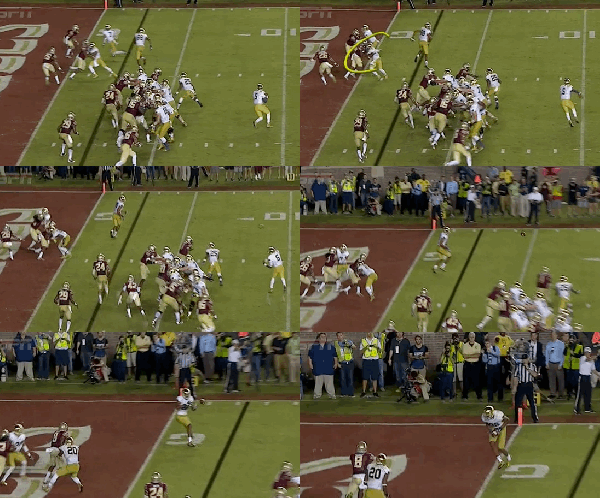
College football fans are probably aware of the recent call against Notre Dame that resulted in them losing the game. Now we see many people talking about the call but very few actually mentioning the actual rule. Some don’t even show video of the play preferring still pictures that they hope supports their view. Here will look at both.
First the rule:

Illegal Contact and Pass Interference
ARTICLE 8. a. During a down in which a legal forward pass crosses the neutral zone, illegal contact by Team A and Team B players is prohibited from the time the ball is snapped until it is touched by any player or an official (A.R. 7-3-8-II).
b. Offensive pass interference by a Team A player beyond the neutral zone during a legal forward pass play in which a forward pass crosses the neutral zone is contact that interferes with a Team B eligible player. It is
the responsibility of the offensive player to avoid the opponents. It is not offensive pass interference (A.R. 7-3-8-IV, V, X, XV and XVI):
…
2. When two or more eligible players are making a simultaneous and bona fide attempt to reach, catch or bat the pass. Eligible players of either team have equal rights to the ball (A.R. 7-3-8-IX).
3. When the pass is in flight and two or more eligible players are in the area where they might receive or intercept the pass and an offensive player in that area impedes an opponent, and the pass is not catchable…..

….
1. Those infractions that occur during a down in which a forward pass crosses the neutral zone are pass interference infractions only if the receiver had the opportunity to receive a catchable forward pass.
…
g. Each player has territorial rights, and incidental contact is ruled under “attempt to reach…the pass’’ in Rule 7-3-8. If opponents who are beyond the line collide while moving toward the pass, a foul by one or both players is indicated only if intent to impede the opponent is obvious. It is pass
interference only if a catchable forward pass is involved.
…

http://www.ncaapublications.com/p-4309-2013-and-2014-ncaa-football-rules-and-interpretations.aspx

Ok there are the relevant rules. It’s clear that the rule is for players trying to catch the ball and it’s clear. “It is pass interference only if a catchable forward pass is involved.” The question is whether the interference “involved” the pass.   I have been watching football for 30 years and have never seen pass interference called involving people other than those who could potentially catch the ball. I have never see calls for pass interference on the other side of the field from where the ball was thrown. This ball was thrown on the sideline and the alleged pass interference was supposedly at the hash mark. So traditional interpretation goes against this call.

Featured image

Now the play. It’s somewhat unclear who the ref actually called the opi on. He may have called it on 20, or he may have called it on 7. Let’s look at each. As for number 20 it is clear that his defender never makes any attempt to cover 88 at all until after the ball would have been uncatchable. He was clearly covering number 20 and even illegally holding his left sleeve. So again number 20 did not do anything to prevent that defender from being able to catch the ball. The ball was uncatchable for that defender because that defender chose to come up and jam 20 at the line and then hold/cover number 20 instead of the person the ball was being thrown to.  That interference seemed to not “involve” the actual pass at all.

But what if the flag was called on number 7? The video clearly shows that the defender covering number 7 also makes no attempt to cover number 88. If he was he would try to step to the outside of number 7 and cover 88. But the video clearly shows that defender steps to the inside of number seven taking away 7s posting route and leading to a collision between both players. It is clear he steps that way and he was not trying to get outside but was picked.  So again the intereference had nothing to do with that actual pass to a different player about 25-20 yeards away.

So it’s quite clear from the video
1) That the ball was not catchable for either of the defenders. And
2) The ball was not catchable for either defender not because of anything the offensive player did but rather because those defenders decided to try to cover players other than the receiver that had the ball thrown to him.

If the receivers were not even trying to cover the receiver that the ball was thrown to and and therefore neither could catch it anyway and it is hard to see how this interference call “involved” the actual pass at all.

← Older posts
Newer posts →

Recent Posts

  • Perspective
  • Rauser Causal Theories of Knowledge and the Moral Argument
  • Why Context Shows Historical Intent for the New Testament but Not the Old Testament
  • Jesus Loves the Canaanites Part 3
  • Randal Rauser: Interpretting the Old Testament Part 2.

Recent Comments

Faith Peters's avatarFaith Peters on Emotion Reason and Truth
ardaacevado84's avatarardaacevado84 on Jesus Loves the Canaanites Par…
Joe's avatarJoe on Rauser Causal Theories of Know…
Unknown's avatarAnonymous on Rauser Causal Theories of Know…
Norah's avatarNorah on In Real Life and Reasonab…

Archives

  • May 2022
  • November 2021
  • August 2021
  • May 2021
  • April 2021
  • February 2021
  • August 2020
  • July 2020
  • February 2020
  • December 2019
  • November 2019
  • October 2019
  • July 2019
  • June 2019
  • May 2019
  • April 2019
  • March 2019
  • February 2019
  • November 2018
  • July 2018
  • January 2018
  • October 2017
  • May 2017
  • April 2017
  • January 2017
  • December 2016
  • November 2016
  • October 2016
  • June 2016
  • May 2016
  • May 2015
  • April 2015
  • February 2015
  • January 2015
  • December 2014
  • October 2014
  • July 2014
  • June 2014
  • May 2014
  • April 2014
  • March 2014
  • February 2014
  • January 2014

Categories

  • apologetics
  • atheism
  • Athesism Christianity
  • Catholic
  • choir
  • chorus
  • christianity
  • Christmas
  • college football notre Dame
  • economics
  • epistemology
  • europe
  • history
  • Islam
  • law
  • logic
  • metaethics
  • Morality
  • Music
  • philosophy
  • politics
  • rationality
  • religion
  • science
  • scripture
  • socialism
  • Songs
  • Trump
  • Uncategorized

Meta

  • Create account
  • Log in
  • Entries feed
  • Comments feed
  • WordPress.com

Recent Posts

  • Perspective
  • Rauser Causal Theories of Knowledge and the Moral Argument
  • Why Context Shows Historical Intent for the New Testament but Not the Old Testament
  • Jesus Loves the Canaanites Part 3
  • Randal Rauser: Interpretting the Old Testament Part 2.

Recent Comments

Faith Peters's avatarFaith Peters on Emotion Reason and Truth
ardaacevado84's avatarardaacevado84 on Jesus Loves the Canaanites Par…
Joe's avatarJoe on Rauser Causal Theories of Know…
Unknown's avatarAnonymous on Rauser Causal Theories of Know…
Norah's avatarNorah on In Real Life and Reasonab…

Archives

  • May 2022
  • November 2021
  • August 2021
  • May 2021
  • April 2021
  • February 2021
  • August 2020
  • July 2020
  • February 2020
  • December 2019
  • November 2019
  • October 2019
  • July 2019
  • June 2019
  • May 2019
  • April 2019
  • March 2019
  • February 2019
  • November 2018
  • July 2018
  • January 2018
  • October 2017
  • May 2017
  • April 2017
  • January 2017
  • December 2016
  • November 2016
  • October 2016
  • June 2016
  • May 2016
  • May 2015
  • April 2015
  • February 2015
  • January 2015
  • December 2014
  • October 2014
  • July 2014
  • June 2014
  • May 2014
  • April 2014
  • March 2014
  • February 2014
  • January 2014

Categories

  • apologetics
  • atheism
  • Athesism Christianity
  • Catholic
  • choir
  • chorus
  • christianity
  • Christmas
  • college football notre Dame
  • economics
  • epistemology
  • europe
  • history
  • Islam
  • law
  • logic
  • metaethics
  • Morality
  • Music
  • philosophy
  • politics
  • rationality
  • religion
  • science
  • scripture
  • socialism
  • Songs
  • Trump
  • Uncategorized

Meta

  • Create account
  • Log in
  • Entries feed
  • Comments feed
  • WordPress.com

Blog at WordPress.com.

  • Subscribe Subscribed
    • True and Reasonable
    • Join 142 other subscribers
    • Already have a WordPress.com account? Log in now.
    • True and Reasonable
    • Subscribe Subscribed
    • Sign up
    • Log in
    • Report this content
    • View site in Reader
    • Manage subscriptions
    • Collapse this bar