• About
  • True and Reasonable Blog

True and Reasonable

~ Religion Philosophy Christianity Theology Logic Reason

True and Reasonable

Category Archives: Catholic

In Support of Religious Extremism

30 Tuesday May 2017

Posted by Joe in Catholic, christianity, Islam, Morality, philosophy, religion

≈ Leave a comment

Tags

Christianity, Islam, religion

No I don’t want to be violent.  And of course, there is no logical reason to think religious extremism means violence.

Many in religious orders give away everything they own and dedicate their lives to Christ including an oath of celibacy.  That’s extreme.   Some monks and sisters dedicate their lives to prayer, and some even take a vow of silence.  That’s extreme.  Those many martyrs present and past could avoid death by simply saying words that would run counter to their religion.  That’s Extreme.   People like Reverend Martin Luther King Jr., chose to be arrested and put their lives in jeopardy in order to act as they believed their religion required.  (Anyone who thinks his actions were not religiously motivated should listen to A Knock at Midnight.)   What about Jainism?  Some practitioners are so non-violent that they were a mask so as not to kill any bugs through breathing and sweep the floor before they walk so as not to tread on any insects.   All of this is extreme religion and has nothing to do with violence.   I could go on with examples but hopefully by now you can see that it is odd to equate religious extremism with violence.


So why has our language developed as if “religious extremism” is violent when obviously this does not fit?  There are at least two reasons.


  • It diverts attention away from Islam for the violence perpetrated in it’s name.
  • It sends the message that religion is fine just don’t take it too seriously.

Of course, these goals fit well with different agendas people have.  What’s my point?  My point is mainly that people recognize how language is being manipulated.  Hopefully, now when you read my title you will have a different and truer impression of what I am saying.


Finally, I will say that this post was inspired by a you tube video by Sam Harris.  Yes, I have been critical of him in many places but I think he made a good point here.

Willi Graf

02 Monday Jan 2017

Posted by Joe in Catholic, history, metaethics, Morality, Uncategorized

≈ 8 Comments

Tags

Catholic, Christianity, ethics, Faith, history, White rose, willi graf

Today 99 years ago Willi Graf was born.  Willi was a member of the White Rose Society.  This society was a Nazi resistance group.  The core members were students Hans and Sophie Scholl, Alex Schmorrel, Christof Probst, and Willi Graf.


All of these core members had very interesting – if short – lives.   Hans and Sophie were Lutheran, Schmorrel was Orthodox, (He is officially an Orthodox Saint) Willi was Catholic and Christof Probst became Catholic just before he died.  I found all of these members to be inspirational.    They got together through a connection to the University of Munich.   Alex Hans and Willi were Medics and served together on the eastern front.

00grafw

Left to right: Hubert Furtwangler, Hans Scholl, Willie Graf and Alexander Schmorell on the Eastern Front (1942)


00scholls3

Left to right: Hans Scholl, Sophie Scholl and Christoph Probst.

They published leaflets trying to change germans’ minds about the Nazis.  They would also spray paint “Down with Hitler”  And “Freedom!” throughout the city.  They would write and print out the leaflets and then they would mail them to people who they thought would be influential, or just leave them throughout different cities.  Willi was not the author of the leaflets but instead he would form contacts in other cities.  They would distribute the leaflets at the same time in different cities so it appeared to be larger than it was.


Before the white rose was even formed, Sophie and Hans Scholl were influenced by Bishop Clemens August Graf von Galen.  There was a transcript of one of his sermons condemning the Nazis pogrom against disabled people.  They actually distributed his sermon just as they would later distribute their own work as the White Rose.

Here are some excerpts from the leaflets:

The first leaflet Said: “…Therefore every individual, conscious of his responsibility as a member of Christian and Western civilization, must defend himself against the scourges of mankind, against fascism and any similar system of totalitarianism. Offer passive resistance – resistance – wherever you may be, forestall the spread of this atheistic war machine before it is too late,..”


The Second leaflet said “…Why tell you these things, since you are fully aware of them – or if not of these, then of other equally grave crimes committed by this frightful sub-humanity? Because here we touch on a problem which involves us deeply and forces us all to take thought. Why do the German people behave so apathetically in the face of all these abominable crimes, crimes so unworthy of the human race? Hardly anyone thinks about that. It is accepted as fact and put out of mind. The German people slumber on in their dull, stupid sleep and encourage these fascist criminals; they give them the opportunity to carry on their depredations; and of course they do so. Is this a sign that the Germans are brutalized in their simplest human feelings, that no chord within them cries out at the sight of such deeds, that they have sunk into a fatal consciencelessness from which they will never, never awake? It seems to be so, and will certainly be so, if the German does not at last start up out of his stupor, if he does not protest wherever and whenever he can against this clique of criminals, if he shows no sympathy for these hundreds of thousands of victims. He must evidence not only sympathy; no, much more: a sense of complicity in guilt. For through his apathetic behavior he gives these evil men the opportunity to act as they do; he tolerates this government which has taken upon itself such an infinitely great burden of guilt; indeed, he himself is to blame for the fact that it came about at all! Each man wants to be exonerated of a guilt of this kind, each one continues on his way with the most placid, the calmest conscience. But he cannot be exonerated; he is guilty, guilty, guilty!”


The third leaflet again tried to trigger the conscience of their fellow Germans ending with  “We will not be silent. We are your bad conscience. The White Rose will not leave you in peace!”


The Fourth Leaflet said:

“…Every word that comes from Hitler’s mouth is a lie. When he says peace, he means war, and when he blasphemously uses the name of the Almighty, he means the power of evil, the fallen angel, Satan. His mouth is the foul-smelling maw of Hell, and his might is at bottom accursed. True, we must conduct a struggle against the National Socialist terrorist state with rational means; but whoever today still doubts the reality, the existence of demonic powers, has failed by a wide margin to understand the metaphysical background of this war. Behind the concrete, the visible events, behind all objective, logical considerations, we find the irrational element: The struggle against the demon, against the servants of the Antichrist. Everywhere and at all times demons have been lurking in the dark, waiting for the moment when man is weak; when of his own volition he leaves his place in the order of Creation as founded for him by God in freedom; when he yields to the force of evil, separates himself from the powers of a higher order; and after voluntarily taking the first step, he is driven on to the next and the next at a furiously accelerating rate. Everywhere and at all times of greatest trial men have appeared, prophets and saints who cherished their freedom, who preached the One God and who His help brought the people to a reversal of their downward course. Man is free, to be sure, but without the true God he is defenceless against the principle of evil. He is a like rudderless ship, at the mercy of the storm, an infant without his mother, a cloud dissolving into thin air….”


Here is a bit from the 6th Leaflet:

“…The Hitler Youth, the SA, the SS have tried to drug us, to revolutionise us, to regiment us in the most promising young years of our lives. “Philosophical training” is the name given to the despicable method by which our budding intellectual development is muffled in a fog of empty phrases. A system of selection of leaders at once unimaginably devilish and narrow-minded trains up its future party bigwigs in the “Castles of the Knightly Order” to become Godless, impudent, and conscienceless exploiters and executioners – blind, stupid hangers-on of the Fuhrer…”

Willi Graf in Particular:

One thing I found interesting about Willi Graf, is that he did not seem to have any authority figure or other adult to lead him to his courageous life.


Hans and Sophie had their father who was a conscientious objector to fighting in WWI.  He did not want them participate in anything Nazi.   Hans however was initially beguiled by the Nazis and became a leader in the Hitler Youth.    Sophie, also initially joined a nazi girl’s group.  However their father seemed to have a clear head and did push them in the other direction.  Their sister Inge Scholl wrote of this later:


“But there was something else that drew us with mysterious power and swept us along: the closed ranks of marching youth with banners waving, eyes fixed straight ahead, keeping time to drumbeat and song. Was not this sense of fellowship overpowering? It is not surprising that all of us, Hans and Sophie and the others, joined the Hitler Youth? We entered into it with body and soul, and we could not understand why our father did not approve, why he was not happy and proud. On the contrary, he was quite displeased with us.”

— Inge Scholl, The White Rose


Alexander Shmorrel was half Russian and so it is no surprise he came to find Nazis revolting – considering he spent time on the Eastern front.     And Probst’s stepmother was Jewish so he presumably would have a strong counterinfluence at home as well.


But Willi’s youth seemed a bit different.  It appeared that his anti-nazi views came solely from his belief that it was inconsistent with his faith.  He joined catholic youth organizations and remained with them even when they were illegal.  He also refused to join Hitler youth when it was mandatory.  Not only that but he would cross his acquaintances names out of his personal address book if they joined the Hitler Youth.   In some of my reading it seemed as though his actions went against his parents wishes.  Not that his parents were  Nazis but that they just wanted the best for him and wanted him to get along.  I should point out that one source says his father was a Nazi leader but I was not able to verify this or get the fuller story.


When Willi was seventeen he marched in a Mayday parade.  But whereas there was a sea of brown marching in step giving “heil Hitler’s” and carrying Swastika flags, he and his friends marched purposely out of step, did not wear brown, and carried their tattered school flag.


A friend commented: “Willie Graf… was one of those young people who have always found it impossible to remain indifferent in the face of injustice.”  This obstinate refusal to comply would lead to fights where it was said Willi would give as good as he would get.

And all of this was before he witnessed the horrors on the eastern front.
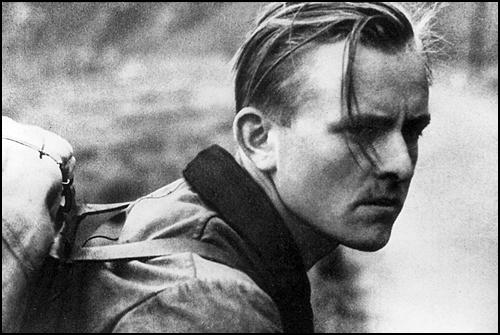
00grafw5

To his sister he wrote from the Eastern front “The war here in the East leads to things so terrible I would never have thought them possible… Some things have occurred… that have disturbed me deeply… I can’t begin to give you the details… It is simply unthinkable that such things exist… I wish I hadn’t had to see what I have seen…. I could tell you much more but do not want to trust it to a letter.”


Even though I live at a time where it is much easier to live a good Christian life I still can relate to him when he wrote in his journal: “To be a Christian, is perhaps the hardest thing to ever become in life.” He was devoutly Catholic and it was said he would attend mass every Sunday even as a college student.  He was interested in the liturgy and composed some alternate liturgies that could be used at mass.   He was also chess player and philosopher.


But perhaps what I admire most about him is that despite harboring doubts he made a decision as to how to live and stuck to it even when it meant death.  He wrote in his journal: “Sometimes, I am certain of the rightness of my course. Sometimes I doubt it. But I take it upon myself nevertheless, no matter how burdensome it may be.”, and  “Sometimes you can’t just go where favoring winds send you. Sometimes one must take a direction which isn’t that easy. You can’t allow yourself to be continually blown about.”


He was not as eloquent at his trial as Sophie or Hans Scholl.   However, despite being interrogated the longest he never gave additional names of any his contacts.   All of the members of the white rose remained loyal to each other throughout their interrogations.  This reminds me of John 15:13  “ There is no greater love than to lay down one’s life for one’s friends.”

In the movie Sophie Scholl last days they make it appear that Willi was very vocal against the actions Sophie and Hans took, which lead to all the arrests.  But even, if this is true, nothing I have read suggests he ever held it against them.   I think they all decided it was just a matter of time before they were caught and killed.

We must remember that Willi and his friends were still quite young during this time.  They died at ages ranging from 21 to 25.  I think as I am older and wiser, not only from an age perspective but a historical one,  I can see how what they did was necessary.  But when I consider the inevitable doubts of the moment to go against all of society, at such a young age, and with full knowledge of the dire consequences, I can only marvel at the dedication of these young men and women.


I have been pondering their lives for a few months now and I am still looking for more information – especially on Willi Graf.  I know there has been a book written on him but it is in German.  I would love to get a translation.


My thoughts here were based on a 2 books,  “A Noble treason” by Richard Hasner and “At the Heart of the White Rose: Letters and Diaries of Hans and Sophie Scholl”  Hardcover – August, 1987 by Hans Scholl  (Author), Sophie Scholl (Author), as well as the movie The last days of Sophie Scholl and the White Rose.


There are also numerouse webpages that I read as well including the following:


http://spartacus-educational.com/GERprobst.htm

http://spartacus-educational.com/GERschmorell.htm

http://spartacus-educational.com/GERschollH.htm

http://spartacus-educational.com/GERgraf.htm

https://libcom.org/library/white-rose-documents

http://www.bls.org/downloads/MFL/White%20Rose.pdf

Gates of Hell and Protestant Church History

07 Wednesday Dec 2016

Posted by Joe in Catholic, christianity, Uncategorized

≈ 3 Comments

Tags

bible, bible alone, Catholic, Christianity, history, Orthodoxy, sola scriptura


Generally speaking I enjoy the topics surrounding Atheism versus Theism and spend most of my time on those.  I will say that I am quite happy with the discussions with non-believers and have found many to be quite cordial despite the topics.  I consider many to be my friends.


I also enjoy discussing the issues surrounding Catholic versus Protestant versus Orthodox.   And this will be the first of what I hope are many posts I will make on this topic.  I am a Catholic and a fairly committed one at that.    But just as I do not think theism is an intellectual slam dunk I do not think Catholicism is a slam dunk either.  In other words, I think there are some good reasons to be atheist, protestant and/or orthodox.     My children go to a Lutheran School.  One that I love.  But sometimes when I see what they are taught I think many protestants must wonder what is he thinking!?  Why is he Catholic?  Well here I would like to offer some insights.  There are few other fairly large reasons but this is a big one.  Lets call this the historical argument.


Ok so let us start with a passage that I believe does lead me to be Catholic or Orthodox.  Actually, I will freely admit that the reasons I prefer Catholicism over Orthodoxy are fairly minor.    I think it’s well past time to end the schism.   But anyway today I want to poke at my fellow protestant readers.


“…I will build my church; and the gates of hell shall not prevail against it.”


Now before this quote Peter says something to Jesus and Jesus says he is Peter an “on this rock” I will build my church.  A lot has already been written on what “this rock” is.  I want to focus on the second part.  Did he build a church?   If so when?    What sort of Church did Christ build?  And finally, have the gates of hell prevailed against his church?


Ok so I think most Christians would agree Christ did in fact found a church.  Moreover, he did it before the New Testament was written.  We see references to the Church in Paul’s letters which are believed to be the earliest NT scriptures.   So it would seem the Church Christ founded could not have been a “biblical church” i.e., one that claims its only authority comes from the bible.  Right?


The Church founded by Christ had to have some other authority beyond “scripture alone.”  If the church Christ founded, is now limited to the bible alone when did this change happen? Did this change right after the scriptures were written?  Or was it after they were considered to be the bible by …I don’t know, someone, a church, Martin Luther  – again I don’t know.

The bible does not say what books are supposed to be in the bible.  Would you agree that Christ’s church has the authority to decide this issue? Or is there some other way to determine what books were inspired by the Holy Spirit and should be in the bible?    There is a dispute, as many of you likely know, between Protestants Catholics and even Orthodox (each bible growing larger) as to which books belong in the bible.  Although this dispute only involves the Old Testament, we do have different bibles.

How can anyone maintain it is “the bible alone” when the bible does not even say what books belong in it and there is a dispute?

Now some maintain that the church is invisible.  If the Church was/is entirely hidden then how would this passage make sense?


“If they still refuse to listen, tell it to the church; and if they refuse to listen even to the church, treat them as you would a pagan or a tax collector.” Matthew 18:17


If we follow this advice what church should we go to?  Who can tell us, for example, what books belong in the bible?  Do we ask the Jews?  Nothing against the Jews but that seems odd as that is really a different religion and not surprisingly they did not include the New Testament.  Why would we ask the Jews instead of Christ’s Church?   So which of the 33,000 plus churches is Christ’s Church?


Did the Gates of Hell prevail?


The problem I have here is that it seems the protestants took such a hard line against the Catholic Church and sort of forced this issue.  If Martin Luther (and just about every other early protestant church reformer) was right and the Bishopric of Rome was indeed the seat of the anti-christ, it is hard to see how we can deny that the Gates of hell prevailed against the Catholic Church.   If you don’t think the gates of hell prevailed then what happened to Christs Church before the reformation?  Was the bishopric of Rome always the seat of the anti-christ?   I have read some protestants claim all the heretics who were persecuted by the Catholic Church were the actual true church.   Is that still a viable position among rational Christians today?  That seems a bit of stretch, but what would the alternative view be?

Of course, the Orthodox Church has an easy answer here.  Although relations have not always been rainbows and lollipops, I don’t think the Orthodox Church ever taught that the Bishopric of Rome was the seat of the Anti-Christ.  But if protestants think the Orthodox Church is a contender for being the Church founded by Christ, which the gates of Hell never prevailed against, why reject Orthodoxy?   It seems to offer a historically coherent view without requiring commitment to as many different Doctrines as Catholicism.


Bearing False Witness – Book Review

17 Monday Oct 2016

Posted by Joe in atheism, Athesism Christianity, Catholic, history, Morality, philosophy, rationality, science, Uncategorized

≈ 3 Comments

I just finished listening to three books by Rodney Stark, Bearing False Witness, Triumph of Faith, and How the West Won.  Here is just a brief review of the first book.


In Bearing False Witness, he describes how he believes the Catholic Church has received unwarranted attacks over the centuries.   As a History buff of medieval Europe and the middle east I have come to draw similar conclusions on a variety of topics.  But this book has that as the central thesis, therefore he marshals the facts for more coherent case.


Stark puts it all together with his central thesis in mind and does so in an informative way.  He covers different issues with a broad brush.  These include the Church’s interaction concerning Nazism, the Crusades, the bible’s formation, treatment of other religions including Judaism, the inquisition, slavery, science, and tyrannical governments. Since he covers the issues in a relatively broad brush the book is an easy read/listen.


The topics included some information that I already learned from other sources as well as new information.  I found that when he covered a topic I already had background information on, he was fair in his treatment.   That’s not to say he took pains to present every possible counter example, but on the whole he was fair.


He opens with a question the question why bother trying to defend the church and dredge through all this history?     It’s a question I asked myself in a prior blog.  But whereas I could not formulate a decent answer, he did by quoting Garrett Mattingly “Nor does it matter at all to the dead whether they receive justice at the hands of succeeding generations. But to the living, to do justice, however belatedly, should matter.”


I really enjoyed the chapter concerning science.   The basic construct of scientific method had already been put together by various monks and religious people in the middle ages.   Later scientists who are often credited as being the fathers of science were putting those principles into use on a very large and impressive scale.   I was quite impressed with the quotations from the scholastics which formed the bedrock of scientific method.

One interesting theory he suggested, was that science did not so much need to fight religion as much as it did the Platonic view that empirical information was not as valid as a-priori ideas.

In the end if you think you will learn the Church always acted just like we do now with our modern sensibilities, you will be disappointed.  However, if you would be satisfied with a strong case that the Church has been a huge force of progress, in science, education and morality then I think this book is for you.


How Abstract Concepts can be Real

15 Wednesday Jun 2016

Posted by Joe in atheism, Catholic, christianity, logic, metaethics, Morality, philosophy, rationality, Uncategorized

≈ 7 Comments

Tags

Atheism, Christianity, epistemology, morality, morals, philosophy, philosophy atheism Christianity ethics morality, reason

I have noticed when I talk about abstract concepts such as morality and ask for evidence of them, I am being unclear to some. I don’t mean that morality is a physical thing somewhere that we can find like a moon orbiting Saturn. But I do mean it is real.

If I say I am taller than my daughter I am invoking an abstract concept – tallness. If I say prove tallness “exists in reality” (or provide evidence that tallness exists in reality) as opposed to our minds that might mean different things to different people. Some people would think I mean we must find an actual platonic-like form of tallness that is perfectly tall. That is not what I mean at all.

I think I “really” am taller than my daughter. That is in reality I am taller. The notion of tallness is something like, when I am standing, the highest part of my body is higher than hers (when she is standing) means I am taller than her. This tie in with reality makes the notion that I am taller than my daughter objectively true. It’s not just that I believe it is true. My belief does not make the statement true or false. Reality makes that statement true or false. That is because tallness has a tie in with reality.

Does morality have tie in with reality? If I believe something is wrong does my belief make it wrong? Or does reality determine whether my belief is true or false. The latter is what I mean when I say morality is objectively real. It is not the case that I necessarily think there is some perfectly moral good form (or perfectly evil form) somewhere that we need to find. What I am asking is 1) whether these concepts have a tie in with reality. And 2) if so, how we would know in what ways morality ties in with reality.

I think I answered the first question with respect to tallness. Yes tallness ties in with reality so we can say it is really and objectively true that I am taller than my daughter. What about the second question with respect to tallness? I think we have empirical evidence that I am really taller than my daughter. We can see me standing next to her. Even a blind person would be able to feel if we are standing, and then feel the top of my head relative to the top of her head. So we have empirical evidence of how “tallness” ties in with reality.

But what about “wrongness”? Here it seems we do not have empirical evidence.

Sure we can substitute concepts for “right and wrong” and “good and evil” and then assert that this new word is promoted by such and such conduct. But whenever I see this one of 2 things is always happening. Either they are leaving the new term so vague that it is pretty much vacuous, and thus the “definition” is vacuous. (that which makes us “thrive” or that which brings “happiness” etc.) Or they do in fact put some constraints on the definition and then I have to wonder if that is really good. I gave a hypothetical that approaches one of the latter views here: https://trueandreasonable.co/2014/12/19/a-moral-hypothetical/

In any case, I do think we can have empirical evidence of abstract ideas.  But in the case of morality the the evidence of morality is the evidence for God.  I talk more about that connection here:

Evidence of Objective Moral Realism


Evidence of Objective Moral Realism

10 Tuesday May 2016

Posted by Joe in atheism, Athesism Christianity, Catholic, christianity, logic, metaethics, Morality, philosophy, rationality, Uncategorized

≈ 2 Comments

Tags

apologetics, Atheism, Christianity, logic, meta-ethics., morality, philosophy, rationality, reason, religion


A fellow blogger and sometime commentator here, Howie, asks some questions for theists.

Meaningful Sadness

He wonders what effect would it have on our morals if we suddenly found out God did not exist.  It’s a great question and I found I could spend allot of time answering this.


In my response I indicate that “I would highly doubt any objective morality exists in reality, and if it did exist I would not believe we had any reliable way of knowing what it was.”


I have blogged extensively about the second part of that statement:

A Problem with the Reliability of Moral Beliefs

Here I want to address the first part.  I want to explain why “I would I highly doubt any objective morality exists in reality” if I found out God did not exist.


But first, I want to reiterate that I do not think there is any logical inconsistency with atheism and belief in objective morality.   That said I am unaware of any actual evidence that an atheist would have for believing in objective morality.    That is, if we were to know there is no God then all the evidence we have for objective morality goes out the window.   It’s one thing to say objective morality is logically possible, it’s another to say we have some evidence that it is true.


To understand my position let’s start with a reverse question for atheists.   Let’s say you suddenly find out that the Christian God exists.  What would that mean for your views on morality?


I would think most people would agree that if the Christian God exists, then it’s very likely that objective moral realism is true.    God orchestrated our existence and reality so that we might be ultimately judged and this judgment will be just.  Reality would have been built with this moral feature.


From that, it follows that evidence that the Christian creator God exists is also evidence that objective morality is a feature of reality.   The evidence that the Christian God exists would be things like the miracles recorded in scripture.  Again people can debate whether this is strong evidence or weak evidence, and what if any burden of proof there is, but it is “some evidence.”  This also happens to be the only evidence that our objective reality contains moral characteristics. (I don’t mean to exclude other religions that teach of a Creator God who had a hand in creating a moral reality.  So yes evidence for Islam, or Judaism would also be evidence for objective moral realism but here for simplicity sake I am just taking Christianity versus atheism.)   So the logic is exhibit A suggest exhibit B.  Exhibit B Suggests exhibit C.  A = miracles B=Christian God exists and C = Objective moral realism is true.


Do we have other evidence that objective morals are actually a feature of reality?  I really don’t think so.  Again because “wrongness” cannot be detected by our 5 senses it seems impossible to have evidence of it outside of testimonial evidence from someone who is not bound by our 5 senses.


The fact that we feel strong guttural emotional responses when we see certain “good” or “bad” actions is not, to my mind, evidence that there is actually a real objective truth to moral claims.  However, if something with a supernatural understanding designed us then of course we might think our emotions are properly cued to these real moral truths.


So the Christian God existing would be strong evidence that real objective morals would exist.  If we were to eliminate that evidence of objective moral reality existing (Say because we “find out” no God exists) then we are hard pressed to find *any* evidence of objective moral reality.   That’s not to say its logically impossible for objective moral reality to exist without God.  Nonetheless, it would be a huge blow to objective moral realism’s case to lose – exhibit B – the existence of God.

“Top Down” and “Bottom Up” Christianity

14 Tuesday Apr 2015

Posted by Joe in Catholic, christianity

≈ 54 Comments

Tags

Atheism, bible, Catholic, Christianity, inerrancy, philosophy

There are many reasons that people believe and trust in God, and I don’t mean to try to address all of them.  But I have come to see some general distinctions in why Christians have faith.   One general way is what I consider a top down Christian who believes for reasons along the lines of: “The bible (or the Church) is inerrant and it says this, so I believe it.”

I have no quarrel with such a view.  However I don’t think those with this view will be particularly helpful in explaining to non-believers why they might also believe.  Non-believers generally don’t start out with the premise that the bible or the Church is inerrant.

Then there are what I would call bottom up Christians.  Descartes I believe is a very good example.  It is the process he goes through to believe in God that I am referring to.  That is, he asked himself fundamental yet difficult questions about his world and his existence and how he could make sense of it.  This led him to believe in God.

Now this distinction is not a very neat one.  Because even if you are bottom up you usually come to give authority to the Church and/or the Bible.  After all are you really a Christian if you don’t give any weight to what we know of Christ and his Church?   Also the top downers usually will have some reasons to believe other than the inerrancy of the bible and/or the church.  So there definitely is overlap in everyone.

I consider myself more of a bottom up Christian.  My reasons for belief in Christ have much more to do with my desire to fundamentally pursue the ethically correct course.  It was through the consideration of what that would mean (meta-ethics) and how I can accomplish that end that supports my belief that Christianity is the way.

Now some might say – that it’s more likely that I am Catholic because I was raised Catholic.  And although I think my philosophical views support Catholicism this is just in my head.  They would say that if I didn’t have this philosophical belief to support my faith then I would just rationalize my faith some other way.  I honestly can’t answer that.   It is hard to answer such counter-factuals.

However I can say that because of my “bottom up” justification I am not so concerned with several of the issues of Christian doctrine that have no bearing on why I am Christian.  These same issues seem to deeply trouble many other Christians.   If there were to be a divide between bottom up and top down Christians, I would say it centers on inerrancy.

By “inerrancy” I think I can refer to both the inerrancy (usually called infallibility) of the Church and the inerrancy of scripture.   For Catholics the inerrancy issue centers on the church and scripture.  For Protestants it centers on scripture.  How important that is to you is a big indicator to me of whether you are a “top down” or “bottom up” Christian.

Let’s consider scripture first.  For Catholics the second Vatican Council said in the Constitution on Divine Revelation (Dei Verbum)

“The Books of Scripture must be acknowledged as teaching firmly, faithfully, and without error that truth which God wanted put into the sacred writings for the sake of our salvation.”

Now for the most part bottom up Christians are fine with understanding “…for the sake of our salvation” to mean if it has nothing to do with our salvation it might contain an error.  So for example if the bible says rabbits chew the cud, or quotes Jesus saying the mustard seed is the smallest seed, this is not going to be something we feel we need to investigate and defend.   It’s hard to see how the veracity of these issues has anything to do with our salvation.

No doubt many top down Christians will be startled by my saying “might contain an error”.   I have read/heard many times arguments along these lines:

  • If the bible is wrong in one place how can we trust it in other places?

As to this argument, I can only shrug.  I suppose the bible could be wrong in other places.  But I believe that scripture teaches “firmly, faithfully, and without error that truth which God wanted put into the sacred writings for the sake of our salvation.”  And that is really the point right?  God seems not to have much of an interest on whether I get every minute and trivial detail of history or science exactly right.  Otherwise he would have spent more time teaching history and science instead of ethics when he was here on earth.

Moreover, I read other books and learn allot from them even if they get some things wrong.  Why should I refuse to read or learn from the books of the bible if they get some things wrong?   This is the same attitude I take with the Fathers of the Church and Saints.   Reading them can enrich my life and faith even if they do get some things wrong.   Do I put more trust in the books of the bible and the teaching of the magisterium?  Sure.  But it can still be a spectrum.

The other argument that usually gets trotted out goes something like this:

  • God knows what is true and false and the bible is inspired, so why would God lie?

Here I just have a different notion of “inspired.”  Some Christians treat inspired as if there effectively was no human part to the writing.  We can imagine the authors of the various books being unable to control their hand as it writes the books of the bible.  Their intellect (or lack thereof) would play no part.   That’s not how I see “inspiration” at all.  I see inspiration more along a spectrum of the common understanding.   Such as this story was inspired by my grandfather. Etc.  OK, I think there was more to inspiration (“God breathed”) than that, when it comes to scripture but it needs to move further in that direction than some sort of uncontrolled hand.  Would God have allowed the human author to make a mistake about something irrelevant to our salvation?  I see no reason to think he would guard against it.

As a Catholic I also believe the Holy Spirit guides the Church.  Might the church make some mistakes?  Sure.  That doesn’t mean that following the Church is not the best way to living a good life and salvation.

At this point some will say I am a cafeteria Catholic when it comes to the Church and a cafeteria Christian when it comes to the bible.  They will say I just take what I like and listen when I want.  I disagree.

It is not like I reject any particular teaching.   I have a hunch that some things the Catholic Church teaches about mortal sin are wrong.  But it is not like I have some big issue with any of the politically hot button issues.  I also don’t have a particular part of scripture that I think must be wrong although I suspect there are some errors.  But these errors are by and large in minor details.

So it’s not the case that I am only Catholic when it suits me.  I really have no problem saying I should try to live by Church teachings and never completely discount any scripture as to how I should act as merely mistaken.  Although I do interpret Old Testament scripture in light of Christ’s Teachings and admit there is certainly friction.

Just because I hold open the possibility that the Church or Scripture might get some things wrong from time to time that does not mean that I don’t hold them up as the most important authorities for how I should live.       It does mean that I will spend less time worrying about whether rabbits chew the cud, or what some convoluted Old Testament passage is supposed to mean.   Plenty of Saints have made it through life without ever a care about these issues that seem to keep so many people from embracing the faith.    Letting go of the minutia will leave more time to focus on what the Scriptures and the Church have rather clearly asked me to focus on.    Trying to strengthen my faith in Christ so I can follow him and be more loving, honest, hopeful, and charitable.

Newer posts →

Recent Posts

  • Perspective
  • Rauser Causal Theories of Knowledge and the Moral Argument
  • Why Context Shows Historical Intent for the New Testament but Not the Old Testament
  • Jesus Loves the Canaanites Part 3
  • Randal Rauser: Interpretting the Old Testament Part 2.

Recent Comments

Faith Peters's avatarFaith Peters on Emotion Reason and Truth
ardaacevado84's avatarardaacevado84 on Jesus Loves the Canaanites Par…
Joe's avatarJoe on Rauser Causal Theories of Know…
Unknown's avatarAnonymous on Rauser Causal Theories of Know…
Norah's avatarNorah on In Real Life and Reasonab…

Archives

  • May 2022
  • November 2021
  • August 2021
  • May 2021
  • April 2021
  • February 2021
  • August 2020
  • July 2020
  • February 2020
  • December 2019
  • November 2019
  • October 2019
  • July 2019
  • June 2019
  • May 2019
  • April 2019
  • March 2019
  • February 2019
  • November 2018
  • July 2018
  • January 2018
  • October 2017
  • May 2017
  • April 2017
  • January 2017
  • December 2016
  • November 2016
  • October 2016
  • June 2016
  • May 2016
  • May 2015
  • April 2015
  • February 2015
  • January 2015
  • December 2014
  • October 2014
  • July 2014
  • June 2014
  • May 2014
  • April 2014
  • March 2014
  • February 2014
  • January 2014

Categories

  • apologetics
  • atheism
  • Athesism Christianity
  • Catholic
  • choir
  • chorus
  • christianity
  • Christmas
  • college football notre Dame
  • economics
  • epistemology
  • europe
  • history
  • Islam
  • law
  • logic
  • metaethics
  • Morality
  • Music
  • philosophy
  • politics
  • rationality
  • religion
  • science
  • scripture
  • socialism
  • Songs
  • Trump
  • Uncategorized

Meta

  • Create account
  • Log in
  • Entries feed
  • Comments feed
  • WordPress.com

Recent Posts

  • Perspective
  • Rauser Causal Theories of Knowledge and the Moral Argument
  • Why Context Shows Historical Intent for the New Testament but Not the Old Testament
  • Jesus Loves the Canaanites Part 3
  • Randal Rauser: Interpretting the Old Testament Part 2.

Recent Comments

Faith Peters's avatarFaith Peters on Emotion Reason and Truth
ardaacevado84's avatarardaacevado84 on Jesus Loves the Canaanites Par…
Joe's avatarJoe on Rauser Causal Theories of Know…
Unknown's avatarAnonymous on Rauser Causal Theories of Know…
Norah's avatarNorah on In Real Life and Reasonab…

Archives

  • May 2022
  • November 2021
  • August 2021
  • May 2021
  • April 2021
  • February 2021
  • August 2020
  • July 2020
  • February 2020
  • December 2019
  • November 2019
  • October 2019
  • July 2019
  • June 2019
  • May 2019
  • April 2019
  • March 2019
  • February 2019
  • November 2018
  • July 2018
  • January 2018
  • October 2017
  • May 2017
  • April 2017
  • January 2017
  • December 2016
  • November 2016
  • October 2016
  • June 2016
  • May 2016
  • May 2015
  • April 2015
  • February 2015
  • January 2015
  • December 2014
  • October 2014
  • July 2014
  • June 2014
  • May 2014
  • April 2014
  • March 2014
  • February 2014
  • January 2014

Categories

  • apologetics
  • atheism
  • Athesism Christianity
  • Catholic
  • choir
  • chorus
  • christianity
  • Christmas
  • college football notre Dame
  • economics
  • epistemology
  • europe
  • history
  • Islam
  • law
  • logic
  • metaethics
  • Morality
  • Music
  • philosophy
  • politics
  • rationality
  • religion
  • science
  • scripture
  • socialism
  • Songs
  • Trump
  • Uncategorized

Meta

  • Create account
  • Log in
  • Entries feed
  • Comments feed
  • WordPress.com

Blog at WordPress.com.

  • Subscribe Subscribed
    • True and Reasonable
    • Join 141 other subscribers
    • Already have a WordPress.com account? Log in now.
    • True and Reasonable
    • Subscribe Subscribed
    • Sign up
    • Log in
    • Report this content
    • View site in Reader
    • Manage subscriptions
    • Collapse this bar
 

Loading Comments...